Computational Optimization & Applications
🎯 Course Vision & Context
The Optimization Revolution in Computational Sciences
In an era dominated by Artificial Intelligence, Machine Learning, and Data Science, optimization forms the fundamental backbone that powers intelligent decision-making systems. From recommending your next movie to orchestrating global supply chains, from training deep neural networks to scheduling autonomous vehicles—optimization algorithms are the invisible engines driving technological progress.
This course positions you at the intersection of mathematical theory and computational practice, equipping you with both the conceptual understanding and hands-on skills to design, implement, and deploy optimization solutions for real-world challenges.
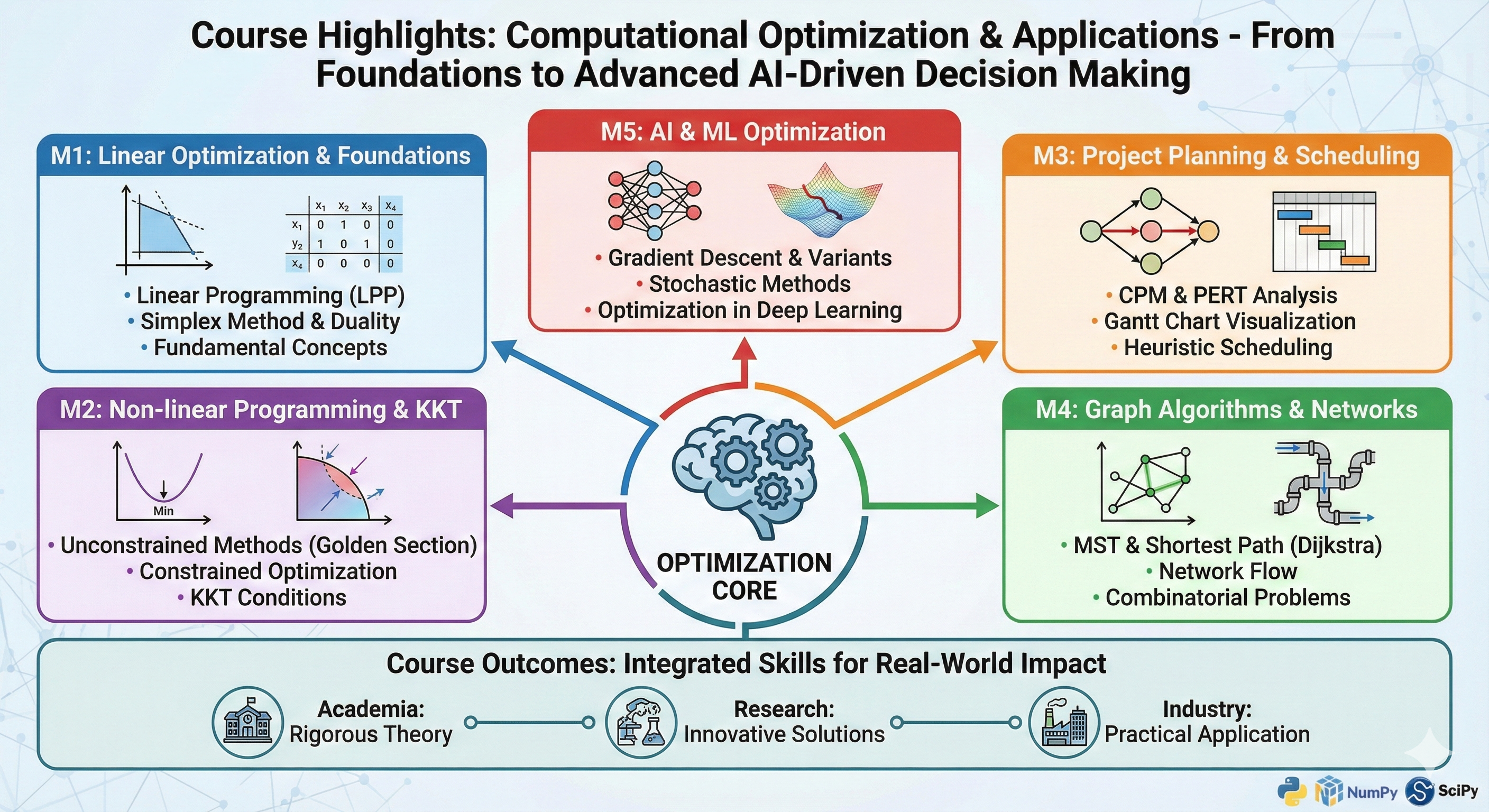
Course Syllabus (48 Hours / 12 Weeks)
Course Overview
Course Code: 20MAT382
Course Name: Computational Optimization and Applications
Duration: 12 Weeks (4 hours/week)
Credits: 4
Total Marks: 150 (Internal: 70 + External: 80)
Intensive Learning Approach
Accelerated project-based curriculum focusing on core optimization concepts with immediate practical application through integrated micro-projects.
Course Objectives
| S.No | COURSE OBJECTIVES |
|---|---|
| 1 | To gain a comprehensive understanding of optimization concepts and their real-world relevance, emphasizing Python as a practical tool for optimization. |
| 2 | To develop proficiency in Python for optimization, including formulating and solving linear programming problems, implementing nonlinear optimization and analysing optimization solutions. |
| 3 | To acquire skills in project planning and optimization techniques using Python. |
| 4 | To master optimization techniques in the context of machine learning, including Gradient Descent, Stochastic Gradient Descent, and various optimization algorithms, all implemented in Python. |
| 5 | To apply optimization knowledge and Python skills to solve combinatorial and graph-based problems, while also considering the ethical aspects of optimization in engineering, logistics, and decision-making. |
Course Outcomes
At the end of the course students will be able to:
| CO Code | COURSE OUTCOMES | REVISED BLOOM’S TAXONOMY LEVEL |
|---|---|---|
| CO1 | Demonstrate a thorough understanding of optimization concepts, problem types, and their real-world applications. | 3 |
| CO2 | Formulate and solve linear programming problems using Python. | 3 |
| CO3 | Implement nonlinear optimization algorithms, and analyse optimization solutions using Python. | 2 |
| CO4 | Develop practical project planning skills and proficiency in applying heuristic algorithms to real-world scenarios. | 2 |
| CO5 | Demonstrate mastery of optimization in Machine Learning, with the ability to apply Gradient Descent, Stochastic Gradient Descent. | 3 |
Core Competencies
- Formulate real-world problems as mathematical optimization models
- Implement optimization algorithms in Python using industry tools
- Analyze and validate optimization solutions
- Develop end-to-end optimization systems for practical applications
Assessment Plan (70 Marks Internal)
Continuous Evaluation (70 Marks)
A. Theory Components (20 Marks)
- Internal Exam 1: 10 marks (Week 6)
- Internal Exam 2: 10 marks (Week 12)
B. Practical Components (50 Marks)
- Assignments/Micro Projects: 15 marks (3 projects × 5 marks each)
- Lab Exams: 10 marks (2 exams × 5 marks each)
- Day-to-Day Lab Work: 15 marks
- Attendance: 10 marks
External Examination (80 Marks)
- End Semester Theory Exam: 80 marks
🗓️ 12-Week Delivery Plan (4 Hours/Week)
Phase 1: Foundation & Linear Methods (Weeks 1-4)
Week 1: Optimization Fundamentals & Python Setup (4 hours)
- Theory (2h): Optimization concepts, problem classification, LP formulation
- Lab (2h):
Pythonenvironment setup,PuLPintroduction - Lab Work: Basic LP implementation (1 mark)
- Micro-Project 1 Launch: Campus facility location problem
Week 2: Linear Programming & Solution Methods (4 hours)
- Theory (2h): Graphical method, Simplex algorithm
- Lab (2h):
PuLPimplementation, constraint handling - Lab Work: Complex constraint implementation (1 mark)
- Attendance: Week 1-2 (2 marks)
Week 3: Advanced LP & Real Applications (4 hours)
- Theory (1h): Sensitivity analysis, duality
- Lab (3h): Transportation problems, case studies
- Lab Work: Transportation problem solution (1 mark)
- Micro-Project 1 Due: Submission (5 marks)
Week 4: Nonlinear Optimization Foundations (4 hours)
- Theory (2h): Unconstrained optimization, Golden Section
- Lab (2h):
SciPyoptimization, function minimization - Lab Work: Nonlinear solver implementation (1 mark)
- Attendance: Week 3-4 (2 marks)
Phase 2: Constrained & Combinatorial Methods (Weeks 5-8)
Week 5: Constrained Optimization (4 hours)
- Theory (2h): KKT conditions, constraint handling
- Lab (2h): Constrained NLP implementation
- Lab Work: KKT condition implementation (1 mark)
- Micro-Project 2 Launch: Nonlinear cost optimization
- Lab Exam 1: Basic LP/NLP implementation (5 marks)
Week 6: Project Planning & Heuristics (4 hours)
- Theory (1h): CPM/PERT fundamentals
- Lab (3h): Project scheduling, greedy algorithms
- Internal Exam 1: Theory assessment (10 marks)
- Lab Work: Project scheduling implementation (1 mark)
Week 7: Graph Algorithms I (4 hours)
- Theory (1h): Graph theory, shortest path concepts
- Lab (3h): NetworkX implementation, Dijkstra’s algorithm
- Lab Work: Shortest path implementation (1 mark)
- Micro-Project 2 Due: Submission (5 marks)
- Attendance: Week 5-7 (2 marks)
Week 8: Graph Algorithms II (4 hours)
- Theory (1h): MST, network flows, TSP overview
- Lab (3h): Advanced graph algorithms
- Lab Work: MST implementation (1 mark)
- Micro-Project 3 Launch: Routing optimization
Phase 3: Advanced Applications & Integration (Weeks 9-12)
Week 9: Machine Learning Optimization I (4 hours)
- Theory (2h): Gradient Descent, SGD, optimization in ML
- Lab (2h): Basic GD implementation
- Lab Work: Gradient descent implementation (1 mark)
- Attendance: Week 8-9 (2 marks)
Week 10: Machine Learning Optimization II (4 hours)
- Theory (1h): Advanced optimizers, neural networks
- Lab (3h): TensorFlow/PyTorch optimization
- Lab Work: Advanced optimizer implementation (1 mark)
- Lab Exam 2: Graph and ML optimization (5 marks)
Week 11: Integrated Applications (4 hours)
- Workshop (4h): Comprehensive system implementation
- Lab Work: Integrated system development (2 marks)
- Micro-Project 3 Due: Submission (5 marks)
Week 12: Review & Final Assessment (4 hours)
- Internal Exam 2: Theory assessment (10 marks)
- Course Review: Comprehensive concepts revision
- Lab Work: Final implementation polish (1 mark)
- Attendance: Week 10-12 (2 marks)
Thematic Project: Campus City Supply Chain
Micro-Projects (15 Marks Total)
Micro-Project 1: Basic LP Implementation (5 marks)
- Timeline: Week 1-3
- Scope: 6 facilities, 3 warehouses, linear costs
- Assessment: Model correctness (2), Code quality (2), Documentation (1)
Micro-Project 2: Nonlinear Optimization (5 marks)
- Timeline: Week 4-7
- Scope: Enhanced cost models, KKT conditions
- Assessment: Algorithm implementation (2), Analysis (2), Validation (1)
Micro-Project 3: Graph & Network Optimization (5 marks)
- Timeline: Week 8-11
- Scope: Routing, shortest paths, resource allocation
- Assessment: System design (2), Performance (2), Documentation (1)
Detailed Mark Distribution
Day-to-Day Lab Work (15 Marks)
- Weekly Implementation Tasks: 12 marks (1 mark × 12 weeks)
- Integrated System Development: 3 marks (Week 11)
Attendance (10 Marks)
- Weekly Attendance: 2 marks per 3-week block
- Full Attendance Bonus: 2 marks for 100% attendance
Lab Exams (10 Marks)
- Lab Exam 1 (Week 5): Basic LP/NLP implementation (5 marks)
- Lab Exam 2 (Week 10): Graph and ML optimization (5 marks)
Internal Exams (20 Marks)
- Internal Exam 1 (Week 6): Modules 1-2 theory (10 marks)
- Internal Exam 2 (Week 11): Modules 3-4 theory (10 marks)
Learning Outcomes Mapping
Theory Outcomes (Internal Exams + External)
- Formulate optimization problems mathematically
- Understand algorithm properties and convergence
- Analyze problem structures and solution methods
Practical Outcomes (Lab Work + Projects)
- Implement optimization algorithms in Python
- Develop end-to-end optimization systems
- Validate and analyze optimization results
- Create professional documentation and visualizations
Grading Rubrics
Micro-Projects (5 marks each)
- Excellent (5): Flawless implementation with advanced features
- Very Good (4): Correct implementation with good documentation
- Good (3): Basic functionality with minor issues
- Satisfactory (2): Meets minimum requirements
- Poor (1): Significant functionality missing
Lab Work (Weekly 1 mark)
- Complete (1): Task fully implemented and demonstrated
- Partial (0.5): Basic implementation with issues
- Incomplete (0): Task not attempted or completely non-functional
Lab Exams (5 marks each)
- Algorithm Implementation: 2 marks
- Problem Solving: 2 marks
- Code Quality: 1 mark
Success Strategy
Maximizing Internal Marks
- Consistent Attendance: 10 marks easily achievable
- Regular Lab Work: 15 marks through weekly completion
- Quality Projects: 15 marks with careful implementation
- Lab Exam Preparation: 10 marks with practice
- Internal Exam Focus: 20 marks through concept mastery
External Exam Preparation (80 Marks)
- Comprehensive theory coverage from all modules
- Problem-solving practice with various optimization types
- Mathematical formulation skills
- Algorithm analysis and comparison
Weekly Preparation Guide
Before Each Week
- Review weekly objectives and deliverables
- Prepare development environment
- Read theoretical concepts in advance
During Each Week
- Attend all sessions (critical for attendance marks)
- Complete lab work during sessions
- Start micro-projects early
- Seek clarification immediately
After Each Week
- Submit all lab work promptly
- Review concepts for internal exams
- Prepare for upcoming assessments
- Maintain code repository
This assessment-focused syllabus ensures students can maximize their 70 internal marks through consistent performance while preparing comprehensively for the 80-mark external examination. The structured approach balances theoretical understanding with practical implementation skills.