🚀 Welcome to Computational Optimization & Applications
📚 Where Mathematics Meets Computational Intelligence
🌉 Bridging Theory and Practice in the AI Revolution1 Introduction to Computational Optimization and Applications
1.1 Why Optimization Matters Now More Than Ever
The exponential growth in data complexity and computational requirements has transformed optimization from a theoretical discipline to an essential toolkit for every computer scientist and data professional. Consider these real-world contexts:
- AI Systems: Training neural networks is essentially an optimization process (Gradient Descent)
- Operations Research: Logistics, scheduling, and resource allocation drive billion-dollar efficiencies
- Data Science: Model selection, hyperparameter tuning, and feature engineering are optimization problems
- Autonomous Systems: Path planning, control systems, and decision-making rely on optimization algorithms
- Quantum Computing: Many quantum algorithms are designed to solve optimization problems more efficiently
1.2 📋 Programme Objectives & Learning Outcomes
1.2.1 Core Educational Mission
This minor programme is designed to bridge the critical gap between theoretical optimization mathematics and practical computational implementation. Upon successful completion, you will be able to:
| Domain | Learning Outcomes |
|---|---|
| Theoretical Foundation | • Formulate real-world problems as mathematical optimization models • Understand optimality conditions and convergence properties • Analyze problem structures to select appropriate solution methods |
| Computational Skills | • Implement classical and modern optimization algorithms in Python • Utilize industry-standard optimization libraries and frameworks • Develop end-to-end optimization pipelines for practical applications |
| AI/ML Integration | • Understand optimization’s role in training machine learning models • Implement gradient-based methods for neural network optimization • Apply optimization to hyperparameter tuning and model selection |
| Problem-Solving | • Design optimization solutions for complex, multi-objective problems • Evaluate solution quality and algorithm performance • Communicate optimization insights to technical and non-technical stakeholders |
1.2.2 The “Smart City Logistics” Experiential Thread
Throughout this course, we’ll employ a continuous practical thread: optimizing logistics and operations for a smart city ecosystem. This narrative provides:
- Real-world context for theoretical concepts
- Progressive complexity as we advance through modules
- Portfolio-building implementation experience
- Industry-relevant problem-solving skills
Smart City Optimization Journey:
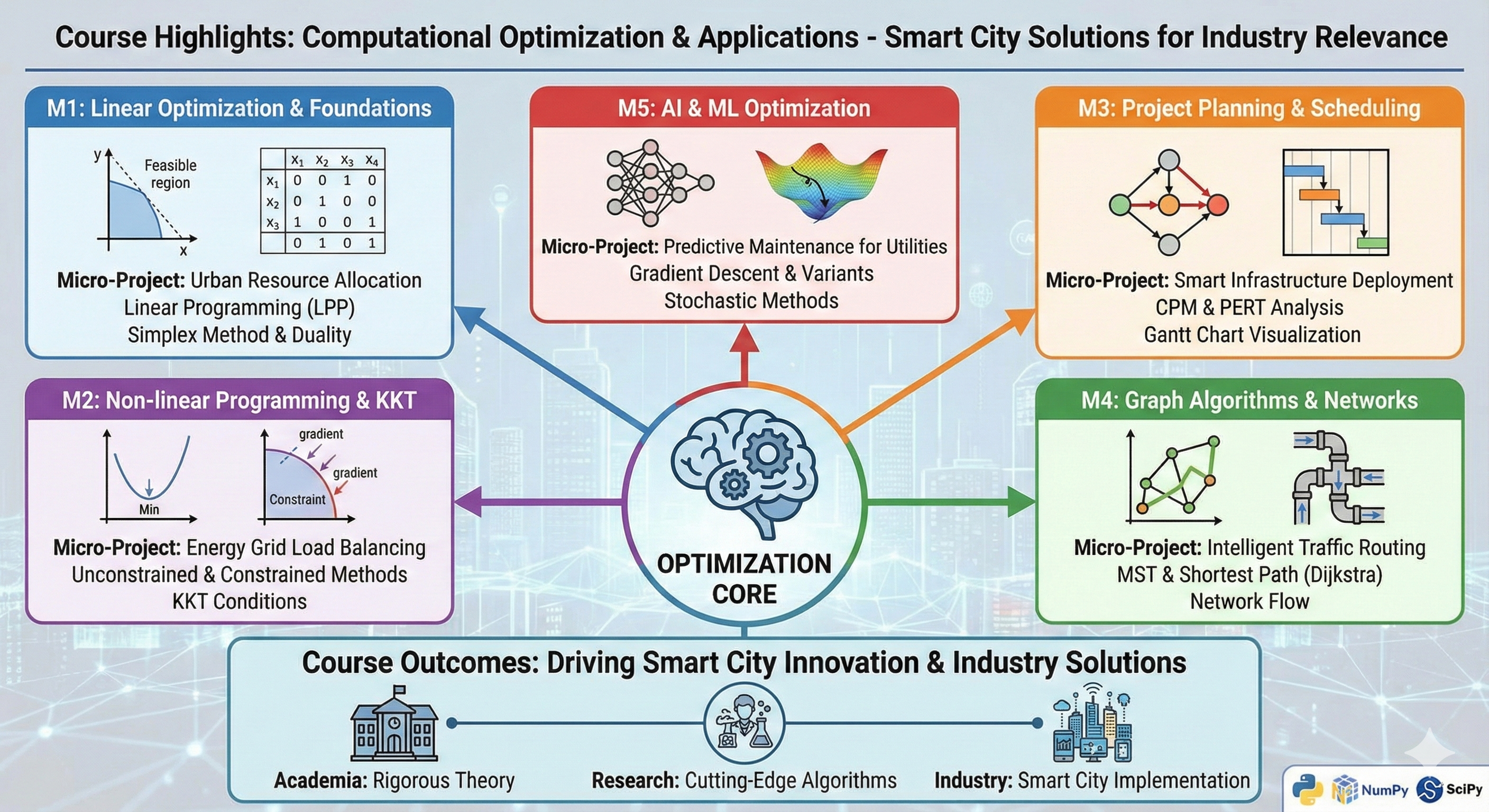
- Module 1: Warehouse Location (Linear Programming)
- Module 2: Fuel Cost Optimization (Nonlinear Programming)
- Module 3: Delivery Routing (Graph Algorithms)
- Module 4: Dynamic Scheduling (Heuristic Methods)
- Module 5: Demand Prediction (ML Integration)
1.3 Course Roadmap & Syllabus Integration
1.3.1 Module Progression: From Foundations to Frontiers
Our journey through computational optimization is strategically sequenced to build from fundamental principles to advanced applications:
1.3.1.1 Foundation Phase: Mathematical Underpinnings
- Module I: Linear Programming & Formulation Skills
- Module II: Nonlinear Optimization & Constraint Handling
1.3.1.2 Advanced Phase: Algorithmic Thinking
- Module III: Project Planning & Heuristic Methods
- Module IV: Combinatorial & Graph Optimization
1.3.1.3 Integration Phase: AI/ML Applications
- Module V: Gradient Methods & Machine Learning Optimization
1.3.2 Assessment Strategy: Theory Meets Practice
To ensure comprehensive understanding and skill development, assessment integrates both theoretical knowledge and practical implementation:
- Series Examinations: Test conceptual understanding and problem formulation
- Practical Assignments/ Micro Project: Evaluate implementation skills and computational thinking
- Final Project: Assess integrated problem-solving and solution design
- Continuous Evaluation: Monitor progress through micro-projects and code reviews
1.4 Optimization in the AI/ML Ecosystem
1.4.1 The Central Role in Machine Learning
Optimization isn’t just adjacent to machine learning—it is machine learning. The entire process of training machine learning models revolves around optimization principles:
- Loss Minimization: Finding model parameters that minimize prediction error
- Convergence Analysis: Understanding when and how algorithms reach optimal solutions
- Regularization: Balancing model complexity with performance through constrained optimization
- Hyperparameter Tuning: Optimizing the optimization process itself
1.4.2 Emerging Trends & Future Directions
The field of optimization is rapidly evolving, driven by advances in:
- Large-Scale Optimization: Methods for billion-parameter models in deep learning
- Automated Optimization: AutoML and neural architecture search
- Quantum Optimization: Quantum annealing and hybrid quantum-classical algorithms
- Federated Optimization: Privacy-preserving distributed learning
- Multi-Objective Optimization: Pareto optimization for conflicting objectives
- Explainable Optimization: Interpretable and transparent optimization processes
1.5 Technical Ecosystem & Tools
1.5.1 Why Python for Optimization?
Python has emerged as the lingua franca for computational optimization due to:
- Rich Ecosystem: Comprehensive libraries for every optimization paradigm
- AI/ML Integration: Seamless connection with machine learning frameworks
- Performance: C/Fortran-backed numerical computing with Python simplicity
- Community: Vibrant ecosystem with continuous algorithm development
- Industry Adoption: Widely used in both academia and industry
1.5.2 Core Toolchain
Throughout this course, we’ll work with industry-standard tools:
Our Computational Optimization Stack:
| Category | Tools |
|---|---|
| Numerical Computing | NumPy, SciPy |
| Linear Programming | PuLP, CVXPY |
| Machine Learning | Scikit-learn, TensorFlow, PyTorch |
| Graph Algorithms | NetworkX |
| Visualization | Matplotlib, Plotly, Seaborn |
| Development | Jupyter, VSCode, Git |
1.6 Getting Started: Your Learning Journey
1.6.1 Prerequisites & Preparation
To succeed in this course, you should have:
- Programming Fundamentals: Basic Python proficiency
- Mathematical Background: Linear algebra and calculus foundations
- Computational Mindset: Willingness to experiment and debug
- Problem-Solving Attitude: Persistence through challenging concepts
- Curiosity and Creativity: Interest in exploring multiple solution approaches
1.6.2 How to Maximize Your Learning
- Engage Actively: Don’t just read—implement every concept in code
- Think Critically: Question why certain methods work better for specific problems
- Experiment Freely: Modify parameters, break code, and learn from failures
- Connect Concepts: Relate theoretical principles to practical implementations
- Build Portfolio: Document your work for future career opportunities
- Collaborate Effectively: Learn from peers through code reviews and discussions
- Stay Updated: Follow recent developments in optimization research
1.6.3 Course Structure and Expectations
This course is designed as a blended learning experience combining:
- Theoretical Foundations: Mathematical principles and algorithm concepts
- Practical Implementation: Hands-on coding exercises and projects
- Real-World Applications: Industry-relevant case studies and problems
- Assessment and Feedback: Continuous evaluation and improvement
1.7 🌟 Welcome to the Journey
You are beginning a journey into one of the most fundamental and powerful domains of computer science and artificial intelligence. The skills you develop here will serve as a foundation for advanced work in machine learning, operations research, data science, and algorithmic design.
As we progress through the modules, remember that each concept builds toward a comprehensive understanding of how to make computers not just compute, but optimize—transforming them from calculators into intelligent decision-makers.
The journey through computational optimization is challenging but immensely rewarding. You’ll gain not just technical skills, but a new way of thinking about problem-solving that will serve you throughout your career in technology.
“Optimization is the science of better. In a world of limited resources and unlimited wants, optimization provides the mathematical foundation for making the best possible decisions.”